The answer block - the only content format with evidence behind it
4 min read Augustyn Głowacki
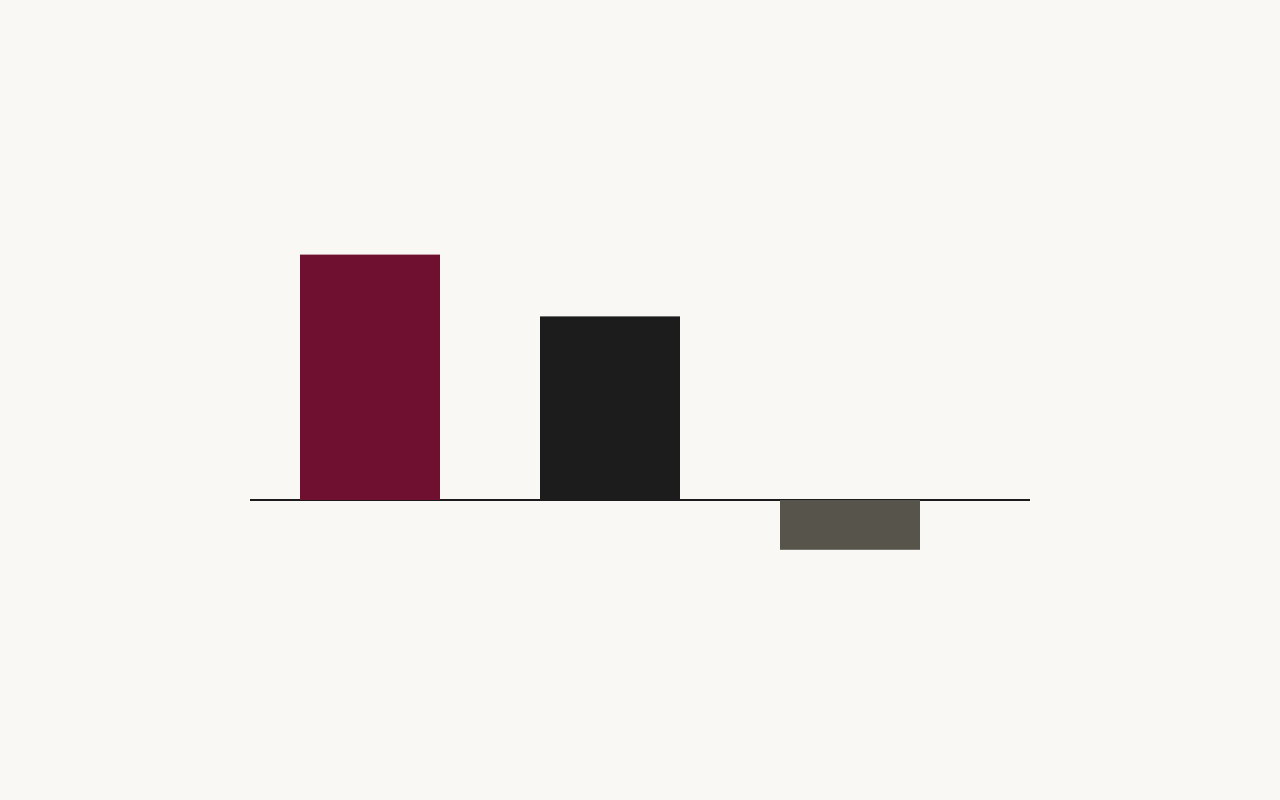
Adding quotations to a page's content improved its share of an AI-generated answer by 40.9%, adding statistics improved it 30.6%, and keyword stuffing made it 8.3% worse - the only one of nine tested rewriting methods to score below doing nothing at all. These numbers come from the one peer-reviewed, conference-published test of content-side answer-engine optimization that exists: Aggarwal et al., "GEO: Generative Engine Optimization," KDD 2024, a 10,000-query benchmark (arXiv 2311.09735). Everything else written about "what AI engines quote" since is either a preprint, a vendor blog, or an agency post repeating one of those two.
What did the study actually measure?
Not retrieval. The researchers built their own answer-generation harness, gave it a query plus five already-retrieved source documents, and measured how much of the word count in the generated answer each source’s content won - a metric called Position-Adjusted Word Count. That’s a critical distinction: the study measures how much of an answer a source wins once it’s already one of five candidates in the room, not whether an optimization gets you into the room. The paper’s authors state this limitation themselves: “owing to the black-box nature of search engine algorithms, we didn’t evaluate how GEO methods affect search rankings.”
What were the actual effect sizes?
Nine methods, tested against a no-optimization baseline of 19.3 points on the primary metric (GEO, KDD 2024). Quotation Addition scored 27.2, a +40.9% improvement - the best of all nine. Cite Sources (adding citations to reliable sources in the body text) scored 24.6, +27.5%. Statistics Addition scored 25.2, +30.6%. Keyword Stuffing scored 17.7, -8.3% - the only method that landed below the unoptimized baseline. The authors’ own wording on that last one: “while widely used for Search Engine Optimization, we find such methods offer little to no improvement on generative engine’s responses.”
“While widely used for Search Engine Optimization, we find such methods offer little to no improvement on generative engine’s responses.”
- Aggarwal et al., “GEO: Generative Engine Optimization,” KDD 2024
That line is about keyword stuffing, the one method of nine that made answers worse, not better.
Did the effect hold up on a real commercial engine?
Partly. The paper’s one test against a live product, Perplexity, showed the effect shrinking. Quotation Addition dropped from +40.9% to +20.7% on Perplexity; Statistics Addition dropped from +30.6% to +8.7% on the same word-count metric, though it rose to +37.2% on the paper’s separate, LLM-judged “Subjective Impression” score. Keyword Stuffing still underperformed, at -9.1%. The direction held, but the shrink wasn’t uniform: Quotation Addition’s effect roughly halved, while Statistics Addition’s effect shrank by about 70%. Anyone quoting the +40.9% figure as a 2026-engine guarantee is overstating what a 2023-era research harness on one commercial engine actually showed.
Why does an answer engine reward quotes and statistics specifically?
Because it can’t paraphrase a number or a named quote the way it paraphrases an idea. “37%” and “$49 per month” travel into a generated answer intact, and they drag their source attribution with them. That’s the mechanism, and it’s the same reason a separate, independently vendor-run study found statistic lines and table rows carry the highest word-for-word extraction rates of any passage format measured - 61% and 58% respectively, against 12% for plain narrative prose (MaxAEO, 3,200 cited passages, hand-classified, no data release - treat as directional).
Table rows and statistic lines get quoted word for word 58% and 61% of the time - versus 12% for plain narrative prose (MaxAEO, 3,200 cited passages, hand-classified, no data release - treat as directional).
What’s the honest limitation on all of this?
The primary engine in the anchor study is a research harness, not ChatGPT or Perplexity as they exist today - GPT-3.5-era models, one fixed prompt template, five sources, one 2023 snapshot. Half the paper’s headline numbers come from a metric scored by GPT-3.5 rather than by humans. And the measurement conditions on already being retrieved; nothing here tells you whether adding quotes and statistics gets a page discovered in the first place. The direction is the most solid finding available in this field. The exact percentages are not a promise about any specific engine today.
What does an answer block that follows this evidence actually look like?
Before: “Server-rendering AI crawlers can’t reach client-rendered content is a growing concern, and it happened faster than expected.” After: “Median time to first citation was 6.81 days across roughly 900 newly published pages (Profound, May 2026).” The second version names a number, a subject, a source, and a period, in one sentence - the shape that survives being lifted out of the page and quoted with the link stripped. It is the rule I apply to every page on this site.