AI-editable websites with a CMS
Your editors and an AI agent work against the same content model, instead of against each other.
You pick the platform. My deepest production experience is Sanity and Storyblok, and I'll recommend one if you have no preference.
The schema is written as code and reviewed like code. Editors keep visual editing on top of it, and an agent proposes changes through the same structure they see in the panel. See projects built this way.
From 3500 USD
- A schema-as-code content model in version control, on the CMS platform you pick, reviewed like application code.
- Visual editing set up so an editor sees the real page while they change it, not a form that looks nothing like the site.
- TypeScript types generated from the content model, so a wrong field name fails the build instead of rendering an empty section.
Experience
I have shipped Sanity and Storyblok schemas on client sites at Bejamas, including a multi-tenant build serving 27 markets from one content model.
What I build with
CMS platforms
- Sanity
- Storyblok
- Prismic
- Contentful
- Tina CMS
- Payload
- Builder.io
The stack underneath
- Astro
- Next.js
- React
- TypeScript
- Tailwind CSS
- Cloudflare
- Node.js
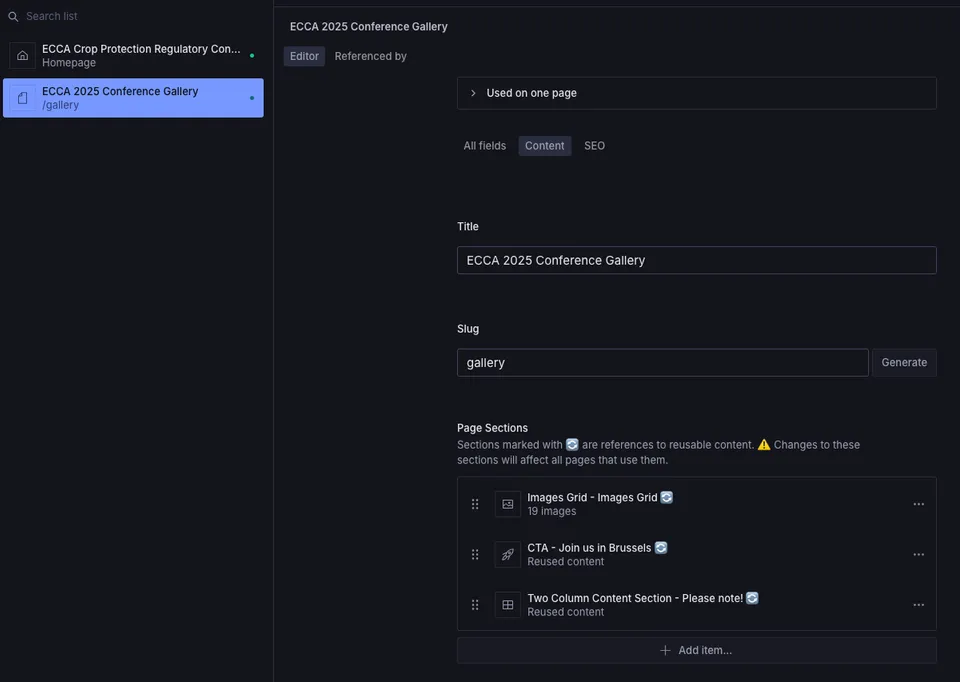
One schema, reused everywhere it belongs
On the ECCA conference platform, the images grid, the call-to-action, and the two-column section shown here are reusable Sanity blocks, not one-off fields - the Studio itself flags when an edit to one will ripple across every page that reuses it. That is what a schema-as-code content model looks like once it is actually built, not just described.

Your editors see the real page while they edit it
Sanity's Visual Editing renders the live page next to the exact fields producing it - here, the ECCA gallery's description and image list, editable in place. That is the visual-editing half of every CMS build I ship, alongside the schema-as-code half above.
FAQ
Questions, answered
Why CMS instead of the no-CMS service?
Because your editors build and rearrange sections on their own schedule, without a developer reviewing every change as a pull request. That's the dividing line from AI-editable websites, no CMS - same discipline about schemas and validation, different interface for the people actually publishing.
Which CMS do you use?
The one that fits your team. I have the deepest production experience with Sanity and Storyblok, so those are my default recommendation when a team has no preference. Contentful, Prismic, Tina, and similar headless platforms work too if that's where your team or your existing content already sits. If you're not sure, tell me what you're building and I'll recommend a platform - and say plainly if one is a poor fit - before I scope anything.
What does schema-as-code mean here?
The content model lives in version control, same as application code - reusable section definitions, typed fields, query fragments that project exactly the shape a template expects. A schema change goes through the same review process as any other code change, so an editor adding a new section type isn't improvising a one-off field structure that breaks the next page that uses it. Without that discipline, one edit gets hand-propagated across every page that pasted the same content instead of referencing it once - see what that costs in practice. A CMS with a real schema behind it closes that gap for your editors the same way it closes it for an AI agent.
What does AI tooling on top of the CMS actually get you?
Types generated from your schema, a documented content model, and an AGENTS.md that tells the agent which section types exist and what each field is for. With those in place an agent drafts entries, proposes section changes and flags broken references against the structure your editors already use, and a wrong field name fails the build instead of shipping an empty section. Visual editing stays exactly as it is for your team; the AI layer is additive, not a replacement for the CMS panel.
What if the scope is bigger than one engineer?
Then I say so early. One engineer is the right shape for a marketing site, a rebuild, or a rescue - not for a platform that needs several people shipping in parallel to hit a fixed date. I work at Bejamas day to day, so for that kind of scope I will introduce you there instead of stretching a solo engagement to cover it. You get the capacity the work actually needs, and I would rather hand the project on than miss your deadline.
In practice
The process
You send the brief
The CMS you're on or considering, and what your editors actually need to build and rearrange on their own. One paragraph is enough to start.
You get a fixed number in writing
A scoped price for the schema, the visual editing setup, and the AGENTS.md, starting at 3,500 USD - set before work starts.
Work ships on that number
Schema, generated types, and visual editing land together, reviewed like application code. No retainer running in the background.
Get in touch