ChatGPT, Claude, Perplexity: how much do their sources overlap?
updated 3 min read Augustyn Głowacki
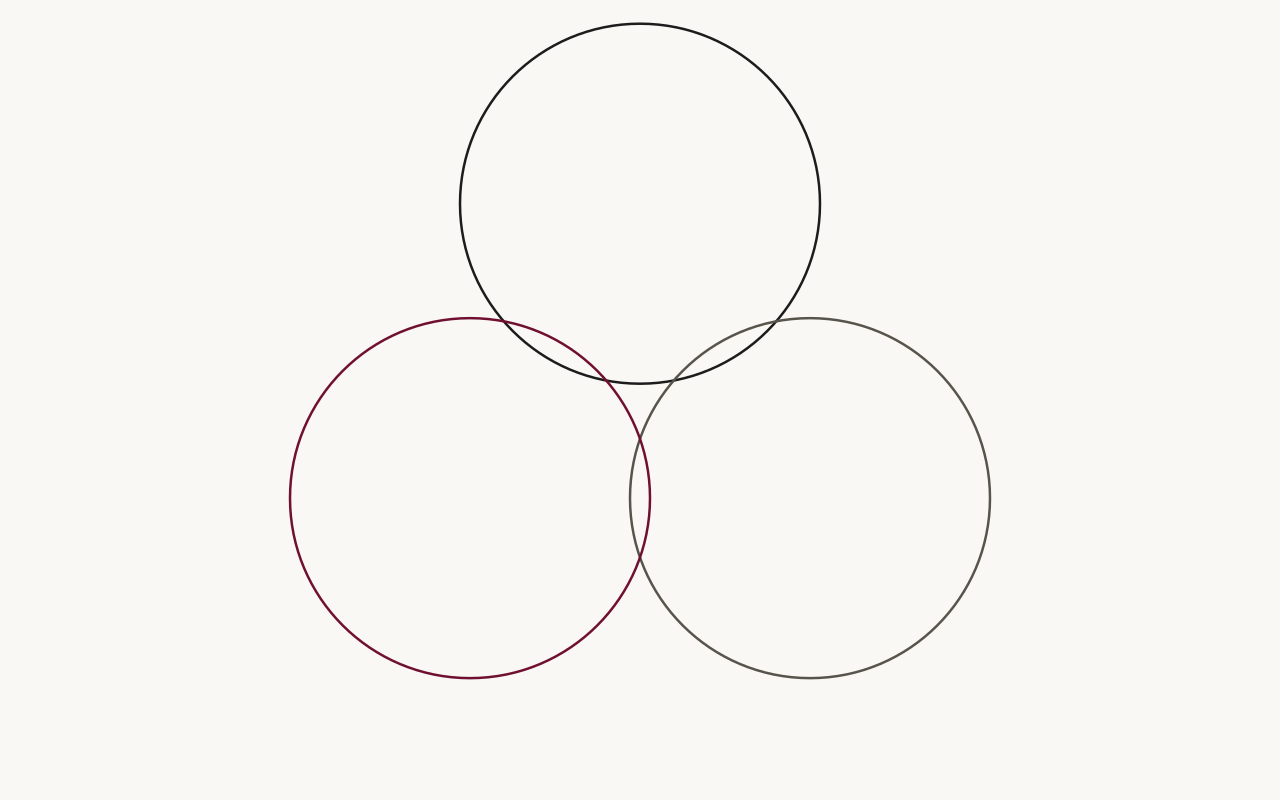
In a University of Toronto study using August 2025 data, Claude, ChatGPT and Perplexity shared about 9% to 25% of cited domains for the same query sets, measured by pairwise Jaccard similarity across categories. Each engine cited 50% to 68% of domains that the others did not cite (arXiv 2509.08919). A citation in one engine therefore gave little indication of whether another would cite the same domain in that study.
How different are the citation sets, exactly?
In the Toronto study, Claude and ChatGPT had pairwise Jaccard similarity of 0.147 for automotive queries. Claude and Perplexity had 0.251, and ChatGPT and Perplexity had 0.096. For consumer electronics, the values were 0.150, 0.200 and 0.088. Depending on the engine and category, 50.3% to 67.6% of cited domains appeared in one engine’s results alone. A separate study of 55,936 queries found that AI and traditional search engines shared 38% of domains, while 37% appeared only in AI engine results (HKUST-GZ and Rutgers, arXiv 2512.09483).
What is the evidence behind those numbers, study by study?
The four studies below measure different things. Check the metric before comparing their percentages.
| Study | When it was measured | Sample | Metric | What it does not tell you |
|---|---|---|---|---|
| University of Toronto, arXiv 2509.08919 | Data collected August 2025 | Multiple verticals, languages and query paraphrases. Query count not stated in the abstract | Pairwise Jaccard similarity of the domain sets each engine cites, per vertical | Google AI Overviews. The pairs quoted above cover Claude, ChatGPT and Perplexity |
| HKUST-GZ and Rutgers, arXiv 2512.09483 | Submitted December 2025; collection window not given | 55,936 queries across six AI engines and two traditional search engines | Share of cited domains unique to AI engines, and mean domain overlap with Google and with Bing | Why any single domain was chosen, or how much of an answer it won |
| Semrush, 21 July 2025 | Published 21 July 2025 | 5,000 keywords | Any-hit rate: whether a Google top-10 domain appears anywhere in the AI answer | How much of the answer it won. One mention counts the same as being quoted throughout |
| Muck Rack Generative Pulse, May 2026 | Published May 2026 | 25 million links | Share of citations going to earned media rather than to brand-owned domains | Per-engine overlap, or which domains your own category’s answers cite |
The Toronto and HKUST-GZ/Rutgers studies compare cited domain sets across engines. Semrush counted whether a Google top-10 domain appeared anywhere in an AI answer. These percentages use different denominators and cannot be subtracted from each other.
Why does ChatGPT overlap least with Google’s rankings?
A researcher observed labels for at least five source routes in ChatGPT’s network payloads: a direct SERP call, Bright Data, Oxylabs, “labrador” and Bing. The mix varied across accounts and over several days (Suganthan Mohanadasan, 14 July 2026). OpenAI removed the observed result_source field on 21 July 2026. In a separate study, ChatGPT’s mean domain overlap was 0.118 with Google and 0.041 with Bing (arXiv 2512.09483). These observations may help explain why its cited domains differ from Google’s rankings.
Which engine tracks classical search rankings most closely?
Perplexity had the highest overlap with Google’s rankings among the engines in the academic study: 0.408 at the domain level. A Semrush analysis of 5,000 keywords found Google top-10 domains in over 91% of Perplexity answers (Semrush, 21 July 2025). Semrush measured whether a domain appeared anywhere, so its percentage cannot be compared directly with the academic study’s overlap score. None of these studies repeated the same query set later, so they show a snapshot.
What does this mean for a B2B site trying to get cited?
In these 2025 measurements, a citation in one engine gave little indication that another would cite the same domain. Muck Rack found that earned media such as review sites, trade press and aggregators received 82% to 89% of AI citations across engines in a study of 25 million links (May 2026 report). To plan coverage for your category, check which domains each engine cites for the questions your buyers ask.